
Sources for Northfield Previous Residents
People associated with an earlier Northfield address are best traced with parallel Northfield records. The Northfield assessor record anchors the current parcel. The Rice County Recorder’s records explain the Northfield ownership chain. Printed directories, phone books, newspapers, census schedules, and obituary files add people associated with the Northfield address in a specific publication year. These sources do not all use the same key, so keep the parcel ID, legal description, lot and block, street form, and dates together. A modern Northfield street address alone may disappear once the search reaches an older deed or plat.
| Source | Years | Where | What It Shows |
|---|---|---|---|
| Northfield Recorder digital index | Historically 1987-current | LandShark and Recorder | Recorded instruments; current cutoff and document types need checking |
| Northfield historic tract books and images | 1854 through the 1990s image project | LandShark tract module and Recorder terminals | Legal tract history, not a complete personal-name index |
| Northfield Polk directories | 1880-1993 listed runs with gaps | RCHS and Library | Published name and address snapshots |
| Northfield News | Digital about 1879-1925; later local copies | Library, Carleton, MNHS, and History Center | Notices, obituaries, property stories, and civic names |
| Northfield federal-census support | Latest generally public schedule: 1950 | Library microfilm and census resources | Household snapshot, not continuous address history |
| Northfield city permits and code files | No verified online case index | Northfield office or data request | Public construction or case dates when available |
Begin with the current Northfield parcel when the property is still identifiable. For an older Northfield era, begin with the closest directory or newspaper date, then use the legal description and plat material to connect it back to the parcel.
Save a Northfield Address First
Rice Beacon is the starting point for a current Northfield parcel. Search the Northfield address or parcel, open the property report, and save the assessed owner, property or situs address, owner mailing address, parcel ID, legal description, subdivision, and lot or block. The Northfield situs address is the physical location used to find the parcel. The mailing address is where tax correspondence goes and can be elsewhere. Neither an assessor owner nor a mailing address is a complete list of people connected with the property.
Beacon’s map tab can also confirm the Northfield parcel polygon and nearby lots. Its property reports may include concise property data, building sketches, and pictures. That evidence identifies the Northfield parcel today; it does not replace the Recorder’s recorded transfer history.
Northfield Parcel Fields for Prior Occupants
Keep a small Northfield record inventory before moving to older sources. A single saved field can resolve an apparent mismatch when an old Northfield directory uses a former street spelling or a deed names only a subdivision. The legal description is the strongest bridge because it is the lot, block, subdivision, certificate-of-title, or metes-and-bounds wording used in land records.
| Northfield parcel ID | County identifier that connects the report, map, and recorded-property research |
|---|---|
| Northfield situs address | Physical parcel address used for map navigation |
| Mailing address | Tax correspondence address, which may differ from the situs |
| Northfield legal description | Recorded land wording that persists when a street number changes |
| Northfield lot, block, and subdivision | Plat-based location details that distinguish one parcel from another |
Keep the Northfield parcel fields with the date of each search. A Northfield property report may change as assessment data changes, while a recorded instrument retains its own recording date and locator.
Trace Northfield Previous Residents Through Deeds
LandShark supplies the ownership sequence behind a Northfield address. Search the current Northfield assessed owner as a grantee, or recipient, in the period when the owner appears to have acquired the parcel. Read the resulting recorded instrument and record the grantor, the party transferring it, the recording date, document number, document type, and legal description. Next, search that prior grantor as a grantee using the same Northfield legal description or lot and block. Repeating the seller-to-prior-purchase loop moves backward through the chain while reducing same-name errors.
- Save the Northfield Beacon owner, parcel ID, and legal description before leaving the parcel report.
- Search LandShark for the current Northfield owner as grantee around the apparent transfer period.
- Open the Northfield instrument entry and copy the grantor, grantee, recording date, document number, and legal description.
- Search the grantor as a grantee for the same Northfield legal description or lot and block.
- Repeat backward, then work forward once as a check that the next Northfield seller and buyer connect.
- Grantor
- The party transferring an interest in the recorded instrument.
- Grantee
- The party receiving that interest, often the current-owner search starting point.
- Chain of title
- The sequence of recorded transfers connected to the same parcel.
- Legal description
- The land description used in a deed or plat, often more stable than an old street number.
Northfield Previous Residents and Tract Books
LandShark’s historical limits matter when researching prior Northfield owners. County material described the Northfield public digital index as historically 1987-current before the tract-image work. Rice County later digitized more than 16,000 historic tract-book images spanning 1854 through the 1990s. Those images extend the Northfield legal-land trail, but their date span does not mean every early instrument has a searchable name index. When the online search is thin, use the tract module, the Recorder’s public terminals, or staff assistance instead of treating a no-result as proof that no record exists.
The Rice County LandShark portal is the entry point for recorded-document and tract research.
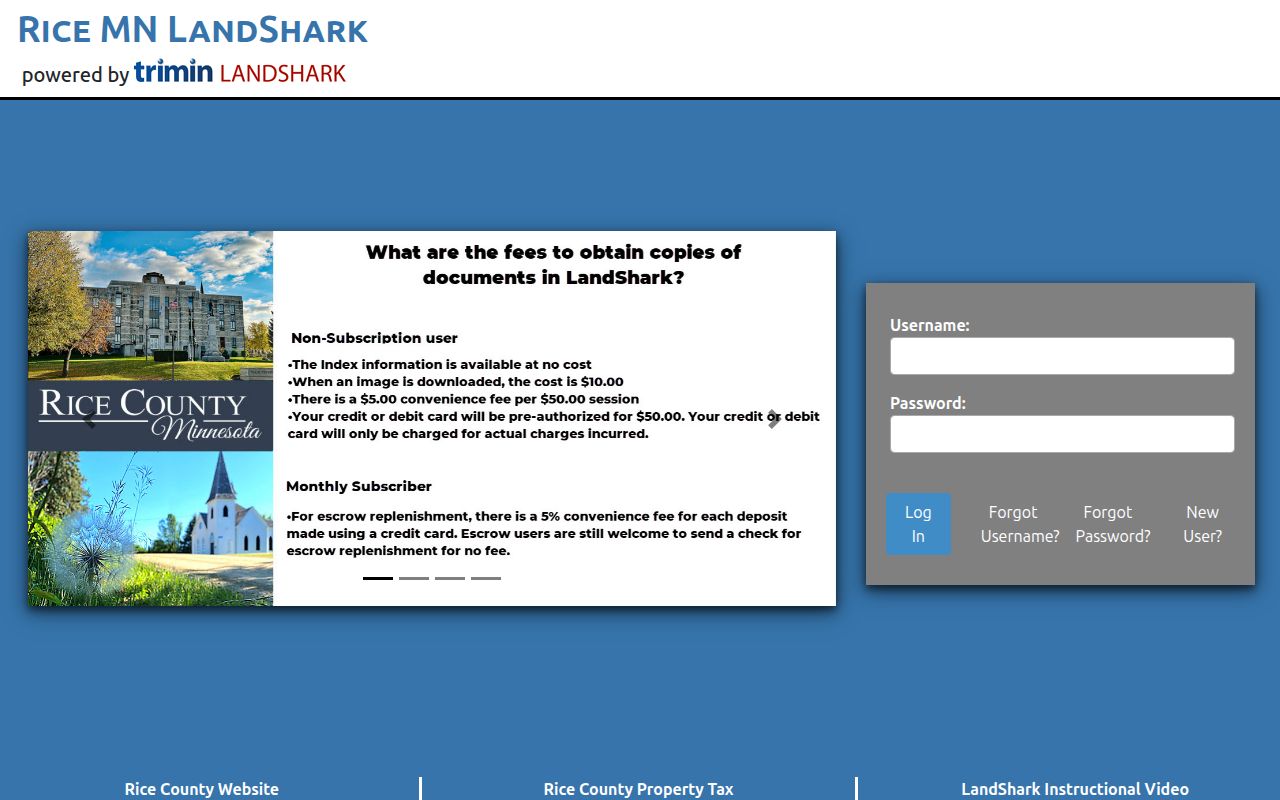
Remote LandShark use for Northfield research is listed at $50 per month, plus $2 per document and a $50 setup fee, while public counter viewing at the Recorder is free and copies are $1 per page.
The county’s preservation story also affects the search. A 1931 courthouse fire spared important records in the fireproof 1924 wings, while the later tract-book digitization made many older legal images more accessible.
Map the Northfield Past-Resident Era
Northfield ownership and occupancy should be checked as separate tracks. A Northfield Polk or phone-book entry ties a name to an address at publication time. A Northfield census schedule adds a household snapshot. A deed shows a recorded transfer, not every person who lived there. Use the nearest available Northfield materials rather than forcing every period into a single source. The latest generally public federal census is 1950, so later household questions need local directories, newspaper files, and other dated records.
- Choose a directory or phone-book year near the period being studied.
- Copy the address and name exactly as published, including initials and street form.
- Compare it with the nearest public census year for the household context.
- Use deeds and plats to test whether the old address refers to the same parcel.
- Use a newspaper article, obituary, or city record to account for the gaps between dated sources.
Northfield census and directory dates do not need to match exactly to be useful. A Northfield address can be tested across the nearest available sources, with the date difference noted in the research record.
Northfield House Files for Earlier Occupants
The Northfield Public Library local-history collection identifies the Northfield Pye Room as the confirmed local place to ask about building and people files, maps, plat material, city documents, and newspaper resources. Its Northfield maps from 1855, 1869, and 1968 help compare a street in different eras. The collection survey also notes a 1910 Sanborn fire-insurance map in the Library Director’s Office. Ask staff about access and other available sheets, because no complete Northfield Sanborn year list was verified.
The 1982 Northfield Downtown Guidebook was compiled from city files and public-library material. It can lead a downtown search toward earlier building names and source files. For the underlying historical directory shelf, use the Northfield city directory collections rather than assuming the guidebook is a full chain of title.
Bridge a Changed Northfield Address
No verified Northfield street-renumbering year or conversion table was found in the research. That gap is a reason to preserve the Northfield legal description, lot and block, subdivision, cross streets, and nearby parcel details. A plat or historic map can connect a printed address to a deed that uses only land-description language. Newspaper wording and building files can supply another bridge when the same property appears under a different street form.
Do not guess that an old and modern number are equivalent. Record the uncertainty, then compare the address against map, plat, parcel, and recorded-instrument evidence.
Northfield News and Obituaries
The Northfield News collection can connect the gaps between a directory date and a deed date. Digital coverage is approximately 1879-1925, while microfilm and local copies extend later. The Library has bound Northfield News from 2003-2011, a newspaper card file through 1998, and an online index through 2008. The History Center also holds bound later copies. Search the name index first, then retrieve the original article from the appropriate medium.
Rice County Historical Society obituary scrapbooks run from 1936 to the present. An obituary can identify relatives, an organization, or a last-known address, but it remains a newspaper or family-authored source that should be checked against an original notice, probate filing, or other primary record.
Northfield Past Households and Obituaries
People tied to an older Northfield address are not always past owners. Directories, phone books, census schedules, and obituaries add the household layer to the Recorder’s legal chain. Public probate material can sometimes identify a decedent, personal representative, heir, or address, but court access rules still apply and restricted material will not appear. For older courthouse files, use the Rice County District Court clerk or the historical repositories named in the local research rather than relying only on online results.
A careful Northfield house history keeps each source in its proper role: parcel evidence identifies land, recorded instruments identify transfers, and dated publications identify people associated with an address.
Lawful use. Use Northfield address records for personal, family, estate, and house-history research. Do not use a name or address to stalk, harass, or harm anyone.